
Events
Join the conversation
Workshops, live discussions, and community sessions on integration architecture and Domain-Driven Design.

Loosely Coupled - Domain-Driven Design in the Agentic Software Development
In today’s world, where most tech conversations are focused around Agentic AI and LLMs, there is a lot of noise. Amongst it there is a recurring sentiment that most developers will have to switch to be more of an architect rather than a developer. The question is: Are we ready for such a shift? How should we prepare? What does this mean?
In today’s world, where most tech conversations are focused around Agentic AI and LLMs, there is a lot of noise. Amongst it there is a recurring sentiment that most developers will have to switch to be more of an architect rather than a developer. The question is: Are we ready for such a shift? How should we prepare? What does this mean?
In this episode of Loosely Coupled we’ll try to answer a few of these questions from the angle of design - a very human practice, that AI is not entirely capable of mimicking on its own. With the help of Alberto Brandolini, the “Supreme EventStormer” we’ll dive into the intersection between Domain-Driven Design and Agentic Software Development! What does Ubiquitous Language mean for a probabilistic behaviour of LLMs?
Let’s talk about language being the key shifting point for the industry! What does it mean the language we use daily suddenly changed from an intermediate design artifact and became the primary executable representation of intent? Is it the same language? Which are the possibilities and pitfalls of collaboration with AI agents in writing, controlling and sharing the domain language?
Join the conversation!
[Webinar] Sociotechnical Engineering in Integration Architecture
![Artwork for [Webinar] Sociotechnical Engineering in Integration Architecture](/events/Webinar_Sociotechnial_Engineering.webp)
Most application integration failures aren't caused by choosing the wrong message broker or IPaaS technology. They happen because the technical architecture ignores the sociopolitical reality of the teams involved. If you implement a high-trust Shared Database pattern between teams that have a low-trust Customer/Supplier relationship, your system will shatter the moment one team changes a schema without asking.
Join us for a webinar, where we will explore this mismatch through the lense of Domain-Driven Design Context Mapping patterns (the social boundaries) to Ecosystem Architectural Styles (the architectural approach) and related integration patterns. We won’t just discuss "trade-offs"; we will look at design heuristics with real-world scenarios.
You will learn to operationalize context maps by understanding: • Why a Conformist relationship (where the upstream team has no motivation to support you) mandates a strictly defensive Anti-Corruption Layer (ACL) within the consumer. • How to implement an Open Host Service using an IPaaS to loosen the coupling between legacy monoliths and multiple downstream consumers. • Where does the Context Mapping language break and needs to be supplemented by new vocabulary, such as Interchange Context.
This session is for architects and engineers who are tired of designs failing when they meet the messy human reality, and guessing how to integrate systems. You will leave with a range of heuristics on how to explore and identify the risks to integrations stemming from the political landscape of your ecosystem. This will give you the vocabulary to express those risks and relationships, and to design for a better future, based on the domain boundaries, not just the technology stack.
What can you expect: • A quick dive into the extended Context Mapping vocabulary designed for Integration Architecture, • Examples inspired by real-life scenarios, • A Q&A with live modelling over questions!
Loosely Coupled - APIs - moving beyond specification and documentation to actionable knowledge
In today's distributed IT world APIs are everywhere! We use them to send statuses, query data, post social-media posts, and most of all we use them in systems in our organizations. But do we really understand the landscapes they create?
In today's distributed IT world APIs are everywhere! We use them to send statuses, query data, post social-media posts, and most of all we use them in systems in our organizations. But do we really understand the landscapes they create?
Let’s discuss why an API catalog is only a starting point! How can OpenAPI and AsyncAPI contracts, quality checks, enterprise architecture, ownership, and runtime relationships be connected? Can we digest this knowledge and derive more meaning out of it?
Joining us this session is Daniel Kocot, Principal Integration Architect @ adorsys, and together we will take a look at what a graph-based knowledge layer makes possible. Can we, using the API Knowledge Stack as a practical example, follow the path from an API definition and a quality finding to an actionable view of the API, its context, its responsibilities, and its next steps.
We’ll be also looking beyond discovery: how APIs can become curated API products, how teams can preserve the intended use and trust, and how organizations can keep their knowledge useful without turning governance into bloated bureaucracy.
How do we move from knowing where an API is to understanding what it means and what to do with it?
Join us in the discussion!
Speakers
 Daniel KocotPrincipal Integration Architect at adorsys
 Karol SkrzymowskiIntegration Architect
Loosely Coupled - Making Generative AI practical for the Enterprises
Being on LinkedIn, substack or medium, or meet-ups and conferences it may seem like everyone is way ahead with Agentic AI adoption. FOMO is prevalent. The most important question is: What is the reality?
Being on LinkedIn, substack or medium, or meet-ups and conferences it may seem like everyone is way ahead with Agentic AI adoption. FOMO is prevalent. The most important question is: What is the reality?
Generative AI is a powerful tool, there is no doubt about that. However, there is a huge difference between experimentation within an isolated environment and releasing AI Agents into the messy reality or IT Ecosystems of all sorts of companies. Building AI solutions in an isolated environment when you have full control over the context, data, or APIs in a greenfield is not directly translatable to the brownfield reality of businesses.
Let’s talk about making generative AI practical for the Enterprises! To guide us through this messy problem space we have invited Michael Bachman, Head of Research, AI and Emerging Technology Strategy @ Boomi! We’ll dive into translating the learnings from experimentation with generative AI into an overview on how to apply this at organizations!
Join the conversation!
Loosely Coupled - CarWash - an AI video experiment!
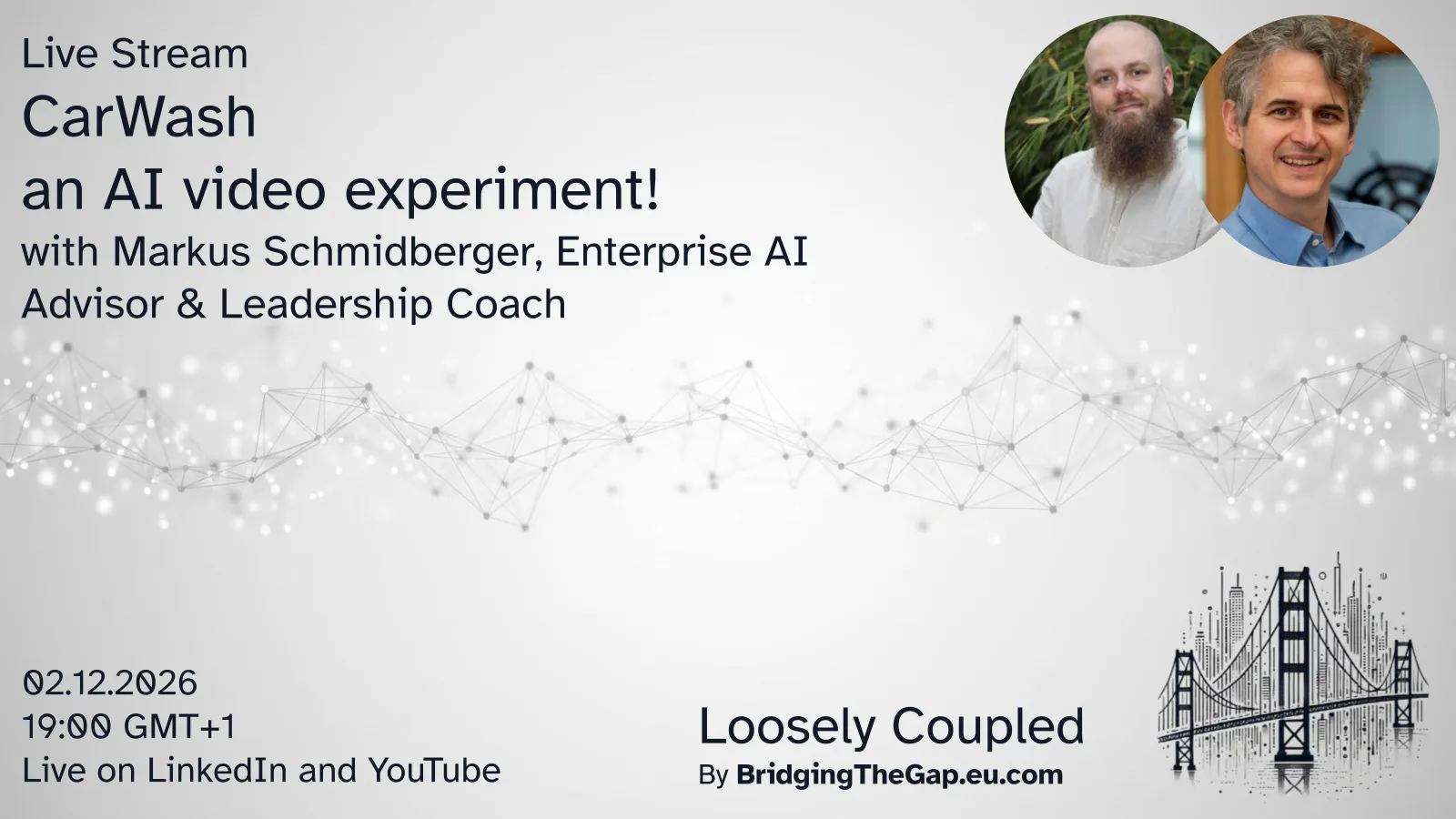
On a daily basis we are flooded by content. All sorts of content. Some platforms fight it, other welcome it. In any case the amount of content online has grown exponentially since ChatGPT was released. Is that a problem? Or is it something that can bring benefits?
On a daily basis we are flooded by content. All sorts of content. Some platforms fight it, other welcome it. In any case the amount of content online has grown exponentially since ChatGPT was released. Is that a problem? Or is it something that can bring benefits?
From the perspective of a user of social media it is harder and harder to filter out AI slop. Platforms like LinkedIn offer mechanisms like “Seems like AI slop”, “Not interested”, or “Unfollow…”. At the same time they promote and suggest such content on interest based algorithms and promote their own AI tools for social media.
A very different situation happens on platforms like YouTube. AI generated content dominates the “Shorts” feed. Synthesized voice, copy pasted video snippets unrelated to the voiceover. Plenty of videos fully generated by AI. Some better, some worse - quality of content is always subjective. The question is how the algorithm treats this content?
This episode we’ll be doing something different! We’ll look at an AI experiment and real numbers! Joining us for the conversation is Dr. Markus Schmidberger, who is currently running such experiments on YouTube and Tiktok! We’ll discuss AI generated content using a real-life example, and its consequences on the world we live in!